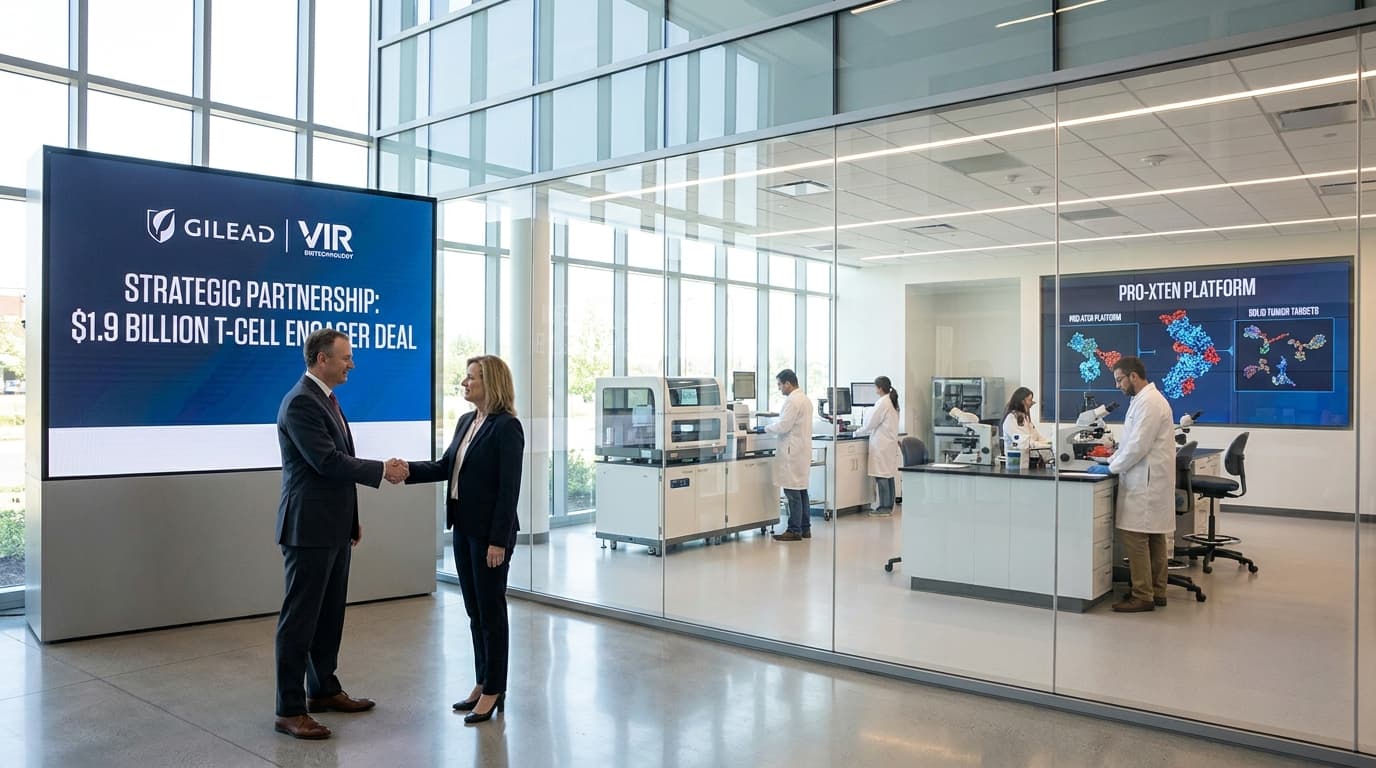
Gilead Sciences has licensed three T-cell engager programs from Vir Biotechnology in an oncology deal that could be worth about $1.9 billion. Vir will receive $90 million upfront, made up of $65 million in cash and a $25 million equity investment priced at a 30% premium, with another $45 million in near-term preclinical milestones and up to $1.74 billion in additional development, regulatory and commercial milestones.
The agreement centers on Vir’s dual-masked PRO-XTEN platform. Vir will handle discovery, design and optimization of three candidates against solid tumor-associated antigens, while Gilead gets exclusive rights to nominate candidates and will assume responsibility for later development, manufacturing and commercialization. Vir CEO Marianne De Backer said the targets for the three programs have already been selected, but she did not characterize the proposed indications further.
The Technology Bet
T-cell engagers have shown anti-tumor activity by directing immune cells toward cancer cells, but their use in solid tumors has often been limited by toxicity. Vir’s approach is designed to address that problem by masking both the tumor-associated binding domain and the T-cell binding domain, keeping the molecule inactive until tumor-specific proteases cleave the masks at the tumor site.
De Backer described PRO-XTEN as a plug-and-play technology because the same mask can be used on an optimized T-cell engager instead of requiring a new mask for each molecule. She also said Vir uses its AI engine, dAIsY, to optimize the molecules. In this setup, AI is positioned as a design and efficiency tool inside discovery rather than as a standalone product story.
The Strategic Picture
For Gilead, the deal adds to an active year in oncology business development. The company earlier acquired Arcellx for $7.8 billion to gain anito-cel, then paid $3.15 billion upfront for antibody-drug conjugate developer Tubulis. The source also notes that Gilead’s flagship solid tumor product, Trodelvy, has run into multiple clinical setbacks, most recently in first-line non-small cell lung cancer.
That makes this Vir alliance notable as a lower-commitment way to widen Gilead’s next-generation immunotherapy options in solid tumors without buying an entire platform company outright. It also fits CEO Dan O’Day’s recent comment that Gilead’s diversification into oncology and immunology has reached critical mass and that future M&A would focus on complementing that base.
For Vir, the transaction reinforces a platform-partnering model. De Backer said the three targets are programs Vir was not interested in exploring itself, allowing the company to focus on its own pipeline while bringing in non-dilutive funding. The same logic was behind Vir’s February partnership with Astellas, which paid $315 million upfront in cash and equity to license the PSMAxCD3 candidate VIR-5500.
The Road Here
Vir already has internal and partnered evidence that the platform can support multiple shots on goal. VIR-5500 has produced phase 1 data, earned an FDA fast track designation in prostate cancer and is planned to enter phase 3 next year, according to De Backer. Astellas and Vir also have six expansion cohorts planned across prostate cancer settings, including combinations with Xtandi, docetaxel and Nubeqa. Vir’s internal pipeline includes the HER2 T-cell engager VIR-5818, with phase 1 dose-escalation data expected later this year.
The broader signal is that Vir is turning masking technology into a reusable business development asset, not just a feature of one lead drug. De Backer said the company has more opportunities in the masked T-cell engager space than it can handle internally and sees room for additional deals, suggesting platform capacity itself is becoming part of the product.